Tuesday, 4 April 2017

Volcanoes, Lakes and Gibbons

Concentration required when driving
Our morning view over Lake Kerinci
Another week in Sumatra and we have made a little progress north - it is such a large and fascinating island. We have now reached Padang where we have stayed for a couple of days while some essential work is being carried out on the Landcruiser. The bushes on the rear springs are in poor condition and a seal on the front steering is leaking, all due to the severity of the potholes in the roads.
Remarkably all the roads here are surfaced, many recently, providing an excellent driving surface, but then many sections are in terrible condition with large sharp edged potholes causing heavy jolts to the suspension. Bizarrely the worst roads tend to be the main roads which carry the heavy lorries. These both break up the surface and in turn make them very slow as they try to avoid the worst of the holes.

The Gong Stone
Driving the main roads is frustrating as it is slow and there are always motorcycles weaving in and out of the traffic - concentration is essential. The side roads are fantastic, but often not signposted, or on any of our maps so again we have tried pot luck with some beautiful scenery.
From Bangkalun we have moved some 500kms up the coast to Padang, but have taken in some beautiful mountains, with the benefit of cooler, but wetter, weather.

Kerinci Volcano dominating the tea plantations
We spent several days in the Kerinci valley, seeing more 3000 year old carved stones, and climbing another extinct volcano (Gunung Tujuh) to see the lake in the caldera. A steep climb up a muddy and root strewn path led to a beautiful lake surrounded by steep tree clad walls of the old crater. We managed to get down just as a thunderstorm broke. Gunung Kerinci is the highest volcano in S E Asia at 3,800m and dominates the area, with large tea plantations on its flanks.

Path up Gununh Tujuh
Gunung Tujuh Crater Lake
From Kerinci we headed north on the minor roads eventually moving into the Minang tribal area where their characteristic peaked houses are a key feature of the landscape. As we were wandering along the village looking at the houses a reporter for a local radio station stopped and interviewed us, then spent half an hour showing us around, including arranging for us to visit one of the traditional houses. We later discovered, when visiting the museum in Padang that the piece had been broadcast and our photo and story shared with staff at the museum. There seem to be very few western visitors to Sumatra - everywhere we go we are asked for photos and people want to talk to us - incredibly friendly and welcoming.
Traditional Minang House
Traditional Minang Street with rice drying
As we drove round the Lake Singkarak area on Sunday morning we were surrounded by motorbikes and pickup trucks packed with people and their dogs - all heading down one narrow road. There must have been hundreds and hundreds of dogs congregating, seemingly for one of their favourite past times of hunting wild boar. The area round the lake is beautiful, terraces of paddy fields amongst coconut palms, all backed by forest rising up the surrounding mountains. It is interesting that as the climate is constant all year round the rice is in every stage of growth, some paddies being ploughed, whilst nearby they are planting, and harvesting from other paddy fields. So good is the climate and so fertile the soil they get three harvests per year.
Parking up that night we were again privileged to have a troupe of Sumatran Surilli Mitred Leaf Monkeys cross near our van and then roost in some nearby trees for the night.
From here we plan to head to Bukit Tinggi and spend some time in the hills and lakes of this most traditional Indonesian cultural area before heading north to Lake Toba.

Rich decoration on traditional Minang house


Rice Paddies - notice rice at all stages,
from just planted to ripe for harvest
Rice Paddies


Sumatran Surilli  - Mitred leaf monkey settled for the night


Saturday, 25 March 2017

Into the Ring of Fire

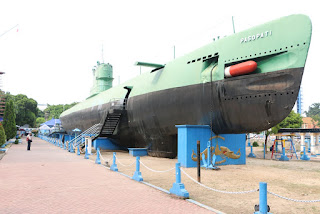
Ex 1950's Russian built submarine in Surabaya 
After 10 days of chasing different bits of paperwork to satisfy Indonesian Customs we were eventually reunited with our cars and are now exploring Indonesia - often referred to as part of the Ring of Fire.
The 10 days in Surabaya passed reasonably quickly as we exhausted the sights and made a couple of trips out for the weekends when we knew there would be no progress with the cars. Surabaya sights we visited ;
- a 1950's Russian submarine, now on the bank of the river some 10kms from the sea!;
- Samoerna cigarette factory where hundreds of people hand roll local Kreak cigarettes, a mixture of tobacco and cloves;
- China town and the Arab Quarter, where we chose three types of dates from the 20 or so on offer,
- Surabaya Motor Show - with six car manufacturers exhibiting four cars each, and around 10 small stalls mainly selling window film
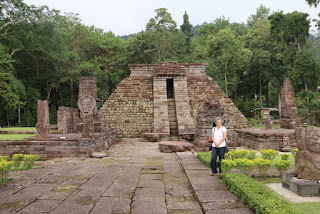
Cetho 10th century Hindu Temple
- as well as visiting several of the 32 shopping malls around town in search of a road atlas of Indonesia.
After an overdose of city life it was great to be back on the road and exploring this fantastic country. Looking for a respite from the heat and humidity of Surabaya we headed to a group of volcanoes to the south west of the city and spent a couple of days visiting the ruins of some of the 9th century Hindu temples, and enjoying the spectacular scenery of volcanoes rising from the plain.
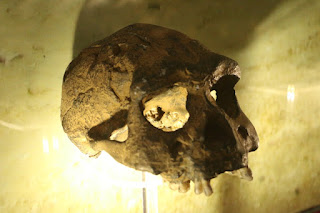
"The Missing Link" - Homo Erectus

Our route took us to Sangiran, the location where a 2 million year old humanoid fossil of Homo Erectus was discovered which is often referred to as the missing link in human evolution. Three excellent museums provided a huge amount of detail on the history of humans, the history of the discoveries and how they link together as well as an idea of the living environment.
Sumatra beckoned so we lost no time driving the remaining 800kms past Jakarta to the ferry which links Java to Sumartra, where we boarded a modern car ferry which crossed the 30kms in a couple of hours.
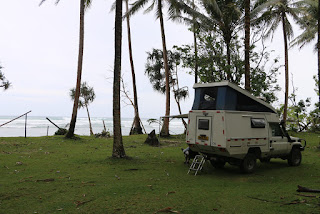
Camping by the Indian Ocean
Whereas Java is very developed, Sumatra feels more relaxed with large areas of undeveloped forest. A couple of days parked on the west coast by the sea watching huge waves, driven by a low pressure crash onto the shore provided a rest. It was time to slow down and start exploring, so we headed north into the mountains along twisting switchback roads and were surprised to discover a large elevated plateau being intensively farmed in the cooler climate.
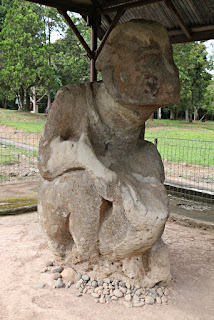
4000 year old Megalith
 The main purpose was to find some of the hundreds of carved megalithic stones which are scattered across the plateau. With many of the roads not showing on Maps.me, or even on Google Maps there was some try this road, turn round and try another, before we found the stones. We first found the groups at Tinggi Hari, and the following day those around Pagar Alam. No one seems to know the specific purpose of these 4000 year old stones, but many are surrounded by stone burial chambers, The stones themselves are carved representations of people and animals and although many are badly eroded some of the detailed features can still be seen along with remains of the red ochre pigmentation.
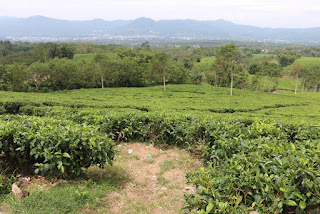
Tea Plantation near beautiful Kapihang
As there were limited camping possibilities available in the area Kepahing police allowed us to camp in their compound. Their generosity extended to guiding us to the local beautiful tea plantation where we were able to meet some of the pickers and see the lovely views over the city, before being taken to an old tea house where we were treated to local snacks along with tea from the plantation. Sadly the Rafflesia flowers in nearby Curup finished flowering 2 weeks before and just the stump of the previously 3m high flower was left.
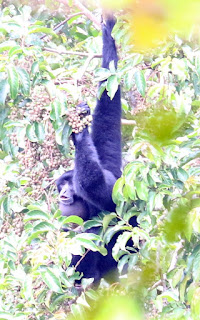
Calling Gibbon
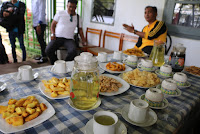
Tea and Snacks
Curup also offers a relatively easy climb to the top of a Bukit Kaba volcano along a well graded, surfaced path which winds through the forested slopes. As we ascended we were privileged to pass close to a group of very loud calling gibbons, catching glimpses of them as they moved around a tree around 30m away. The final ascent to the crater rim comprises around 250 steps, but the views into the crater with its sulphurous fuming vents is worth the climb. Already we have seen so much and we are only 1/6 of the distance up the west coast of Sumatra.
Bukit Kaba volcano crater


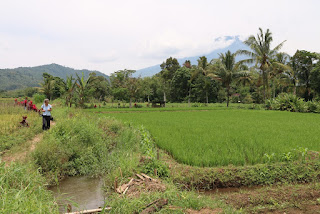
Typical scenery - rice paddies and volcanoes


Tuesday, 7 March 2017

Penang and onto Indonesia

Jungle trail
Turtle Beach Penang
Another very fast border crossing in Malaysia meant we were soon on the train to Butterworth and Penang Island where we arrived very tired after two days of pretty continuous travel. The reason for choosing Penang is that it has an Indonesian consulate which is requires less paperwork before it will issue a Visa. We applied on the Friday, and collected the Visa on Tuesday afternoon - an excellent service. Georgetown on Penang is an old colonial era trading port and a World Heritage site, but one which has not been overly smartened up and has gained its status for the remarkable mix of cultures and temples in a very small area. The streets are still networks of small two storey, relatively shabby buildings, but which are all true working places, with individual businesses operating ranging from workshops and mechanics, through small stores to specialists in wholesale of hardware, food, etc. etc. An amazing mix.

Resting Flying Lemur
There are also several clear quarters including a very vibrant Indian sector with many gaudy Hindu shrines and temples, an Arab sector with mosques, a Chinese sector as well as many European colonial buildings. So you find a mosque just around the corner from a Buddhist temple which has a Hindu shrine across the road and a Christian church further along. The west of the island is a national park and is covered in rainforest with some trails leading to white sandy beaches. One is a nesting ground for turtles and there is a turtle research station which collects the eggs and moves them to a protected area to hatch. During the six days we used the excellent bus service to get to and from the consulate, and also to get to the national park where we walked both the main trails.
The other feature of Penang is the excellence of the food. Not only is it of a very high standard it is very varied, featuring dishes from all the communities represented in its makeup. A vibrant place with lots to see and some lovely street art surprises around street corners.

Little India - Penang
Street Art
Leaving Penang we headed straight to Surabaya in Indonesia to meet the container with the cars. the ship having arrived on the Thursday we were unable to get a customs inspection until the following Monday, and will not get the cars back until tomorrow (Wednesday). They have now cleared customs, and are each in one piece, so that's a relief. A week is Surabaya is a long time so we headed to the local island of Madura just across the water which is another world. We were the only white faces we saw during the weekend and we attracted lots of welcoming calls of Hello Mister. One evening a local English teacher asked us to have dinner at his house so we could talk to his students, some of whom had only been studying English for a few weeks. It made for an interesting evening. Many of the students who were in their 20's had not been off the island (which is connected to Surabaya, 50kms away by a road bridge). With no particular attractions we took a Bemo along the coast to a small strip of sand then walked the 7kms back to town. Once we have our vehicle we plan  to head north to Sumatra.
Live Street Art
 
Penang Street business


Thursday, 23 February 2017

Goodbye Camper - for now


Camping in Highlands amongst fir trees
Much has happened since the last posting, including shipping our van, along with a Toyota belonging to Nicolette and Jeroen (fellow travellers across China) to Surabaya where it should arrive on 2nd March. before shipping we made a quick trip to the Cardoman Mountains, an area in the west of Cambodia which is still primarily untouched forest and home to wild elephant and tigers. Unfortunately we did not see any of these but were amazed by the great Hornbills, which fly overhead like B52's having a body length of around 1.2m and massive wings.

Hornbill
Outrez Beach campsite
You hear them before you see them from the loud whoosh, whoosh noise their wings make. As we needed to discuss the options for shipping the vehicles with Nicolette and Jeroen we headed down to Sihanoukville and met up with them by the beautiful Outrez beach where we camped for three nights while cleaning the inside and outside of the van ready for shipping. An idyllic spot which has not yet been developed with white sands sloping into a gentle sea, shading trees over and no bars or restaurants.
Sunset at Outrez beach
Both vehicles just made it into the container once we had removed the spare tyre from the roof but it was a real squeeze to get round the cars to strap them down. However after around 1.5 hours all was strapped down to everyone's satisfaction and we locked the container.
Ready for Shipping
We were without the van but needed to collect the original bill of lading which would not be ready until the following Tuesday, so we went 80kms along the coast to Kampot where we spent a couple of nights and explored the area including a small 8th century temple inside a cave and a pepper farm. A memorable evening cruise on the river for the sunset and fireflies completed the day.

8th Century temple in Cave
Having collected the bill of lading we headed straight to the Thailand border, our visas ran out the next day, and headed straight to Bangkok for an overnight stop before catching the overnight train to the Malaysian border and the train to Penang, where we plan to get our Indonesian Visas. The differences between Cambodia and Thailand and Malaysia are striking. Thailand has such a good road infrastructure, and is much cleaner and more developed than Cambodia with Bangkok more like Singapore than Phonm Penh - sweeping road networks and much high rise development. Malaysia is a step up again, excellent trains, clean streets and generally well maintained housing.


Sunday, 12 February 2017

Angkor and Change of Plans

Angkor Wat Temple
Bas Relief at Angkor Wat
From Phnom Penh we travelled north to Siem Reap and the World Heritage site of Angkor Wat. Like the Grand Canyon, it does not matter how many photographs you may have seen, they cannot convey the vast scale, and all of it hand dug, and hand built between the 8th and 13th centuries. Ankor is a huge site with numerous different temple complexes, Angkor Wat being the biggest and most famous, so there is a real danger of being "templed out". Consequently we spread our three days of access over four, taking a rest day in between to visit the Tomle Sap lake and its "floating villages", they are really villages on very tall stilts which are flooded in the wet season. Over the three days we managed to visit around a dozen of the temple complexes, choosing ones from different periods ranging from 800AD to 1300AD and styles. The common feature is that they were all overrun by forest and have needed a great deal of restoration. We were surprised at the detail, quality and extent of the bas relief carvings on the external walls of the temples with hundreds of feet of carvings surrounding Ankor wat as well as many of the other temples.
Camper at Bayon Temple
They were very reminiscent of the bas relief carvings at Persepolis. One temple was left relatively unrestored to show how they all looked and was famously used for the Indiana Jones film with huge Fig Tree roots growing out of, and over the buildings. From Siem Reap we stopped at Prasat Tembour where there are over 100 brick temples from the pre Ankor period
Indiana Jones
Whilst in Siem Reap we learned from the Thailand department for Land Transport that we would not be given a permit to cross Thailand as they have now banned camper vans. Disappointing as we were looking forward to Myanmar and India, but have instead decided to ship the van to Jakarta in Indonesia and spend a few months driving through the Archipelago towards Australia, hopefully shipping to Darwin in late May. While the vehicle is being shipped, which should take around 10 days we will backpack quickly through Thailand and Malaysia to Singapore where we can get a flight to Jakarta to collect the vehicle.
We ventured back to the cooler highlands in the east for a two day trek where we saw many birds and caught glimpses of gibbons, and langaur monkeys, but they were high in the trees.
"Floating" Village
After a couple of hot humid days were spent in Phnom Penh trying to arrange a visa for Indonesia, but we have been unable to get a letter of introduction from the shipping agent so will have to resort to a Visa on arrival, unless we can get a visa in Malaysia where it is claimed they are less insistent of having a letter of invitation.

Pre Ankor temples near Kampong Thom
This entry to the blog is written from a much cooler Kiriom National park where we have spent the day beside a small river in an open forest of conifers, very relaxing and a pleasant change from the hot humid Mekong Valley.


Carved faces at Bayon Temple

Huge invasive Fig Trees

Sunday, 29 January 2017

Eastern Cambodia

Ban Lung - Waterfall
We have had a very relaxing week in Eastern Cambodia and are amazed by how different it is to Laos in so many ways.
- Cambodians are much more friendly, and interactive with many speaking some English, in Laos wherever we camped we were left pretty much alone.

Sen Monorom waterfall
- There is much more organised agriculture in Cambodia with large scale plantations, and little untouched forest outside the protected areas whereas Laos has large areas of unspoilt forest and little large scale agriculture.
- Cambodian roads are much better, even the dirt roads are well graded and are better maintained than in Laos.

Logging Road into Forest
National Museum
The Eastern region of Cambodia is more hilly then the west and has rubber, cashew nut, banana and cassava plantations over much of the ground. Being at around 700m it is cooler than the Mekong Valley, feeling positively cold some nights when it was particularly windy. We spent a couple of days in Ban Lung in the north east visiting a nearby volcanic lake and a couple of waterfalls, whilst enjoying a couple of nights of luxury in the Tree Tops Eco Lodge. 165kms south we stayed near Sen Monorom where we had planned to organise a trek to visit the gibbons, but the guide had just married and was on honeymoon, so we will return next week.

Lakeside Campsite
Instead we have dropped down into Phnom Penh , a bustling city boasting a number of new skyscrapers as well as some lovely old French Colonial buildings, and a lovely riverfront where families picnic overlooking the water. We spent the day visiting the national museum which houses some fantastic sculptures from the Ankor Period followed by a very thought provoking and moving visit to the genocide museum S21 where 20,000 people were tortured and sentenced to death during the Pol Pot years. It is extraordinary how a nation can inflict such cruelty on its own people and fall under the spell of a tyrant, but sadly it is not unique, and was not the last genocide of the 20th century.

French Colonial Buildings
Over the next week we head for Ankor Wat, and will hopefully find out whether we can get a permit to cross Thailand as planned, or we will have to make some other arrangement, perhaps shipping to Indonesia instead.


Monday, 23 January 2017

New Year - New Country

Mekong waterfalls
Mekong Car Ferry
Irawaddy Dolphin
After a fantastic four weeks in the UK over Christmas when we were able to celebrate with all the family and catch up with friends we returned to Vientiane in Laos. Mike's garage had greased all the wheel bearings and we had the air conditioning checked and a small leak repaired. Hopefully we will be able to keep cool from here on. With nothing else to detain us we headed south towards the Cambodian border, stopping for a couple of days at 4000 islands, an area of many small islands in the Mekong River where it cascades down over a rock shelf. The river at this point is several kms wide so there are many waterfalls between the islands. Just south of the lower island there is a pod of the endangered Irawaddy Dolphins so we took a boat to where they live and were privileged to see several surfacing around 50m from the boat. The island of Don Khong is only 8kms long and is serviced by a passenger ferry. Despite being a backpacker destination and a good stopover on the route from Cambodia to Vientiane it is relatively peaceful (apart from the overnight concert) so we hired bikes to travel round visiting another waterfall, and a couple of very sandy beaches. During the French colonial period a short railway was constructed along the island to get two gun boats past the waterfalls, so they could patrol the upper Mekong.
Finally on Sunday we crossed into Cambodia through an almost deserted border post, with one of the fastest border crossings in this part of the world so far. Cambodia feels very different, fewer vehicles on the roads and much flatter, but we will discover more over the next couple of weeks.

Mekong sunset


Water Buffalo