Wednesday, 26 February 2020

Kwa Zulu Natal and eSwatini (Swaziland)

Just hatched turtle heading for the sea
Give way, elephant approaching
Baby Rhino - mum is just behind him
Back in Johannesburg we were reunited with the van. After repacking and reorganising the van we headed south to the coast of Kwa Zulu Natal (KZN) and the parks along the coast. This remote section of coast is the nesting site for thousands of loggerhead and Leatherback turtles. After three days of fine rain we were rewarded with seeing Loggerhead turtles emerging from their nests, as well as a female which had clambered up the beach, but found the sand too hard after the rain to excavate a nest, so she returned to the ocean. We had a very relaxed couple of weeks, visiting several National Parks and Reserves. Hluhluwe hosts the big five, and we were fortunate in seeing 21 white rhino including one mother and baby which came up to within 1 metre of the van - a very special moment. Tembe Park near the Mozambique border houses some of the biggest tuskers, and we came face to face with one on a track, fortunately he found a way through the surrounding forest. On our way out of the park we were stopped by a herd of around 80 buffalo standing across the track. The countryside is all very green after the rain, but being out of season the campsites are deserted, so we have had the pick of locations. Arriving at one of the campsites we found a UK Landrover parked up, belonging to Neil and Julie Lee. We spent a couple of evenings and a day chatting about overlanding and their involvement with iOverlander, Overlanding Sphere and various other facebook groups which they help manage.
A couple of white rhino with magnificient horns
Malolotja National Park
They were heading south and we drove north to eSwatini. The border crossing was easy and we entered a relaxed, very green and friendly country surrounded by mountains. The Malolotja reserve in the western mountains is a large unspoilt open area of high veldt, offering the promise of cooler weather. Arriving under an overcast sky we stopped in their campsite as an incredibly active thunderstorm broke and passed overhead. For three hours we were surrounded by almost constant lightning and very loud thunder. After visiting the viewpoints the following morning but seeing little as it was still cloudy we headed north to a couple of the game and nature reserves. At Hlane Royal Reserve white rhino come in the evening and morning to the water hole where they are inquisitive but short sighted so several times headed towards us, eventually taking fright when within 10m. The east of the country has some huge sugar cane farms, but has large undeveloped areas still covered in natural forest, resulting in large populations and diverse species of birds. We finally tore ourselves away and headed north to Mozambique.
Near the S Africa eSwatini border
 

Inquisitive giraffe


Buffalo take priority on the track

Stunning sunsets


Baby Rhino


Passing elephant


Blesbok

Water thicknee defending nest against passing white rhino

African Harrier Hawk
 

The North of Madagascar

Zebu trampling a rice paddy
The second half of our stay in Madagascar was in the north. Returning up towards Tana we stopped at a local zebu market, Farmers with up to a dozen of the local zebu cattle stand around in a open area while prospective buyers walk between them examining the cattle, then haggling over the price. Fascinating to see, with many of the animals bred in the south destined for a 2 day drive up to Tana for the markets there. The Zebu, apart from being bred for meat are used on the farm for pulling wagons,
Zebu Market
ploughing the fields, and just trampling the ploughed fields before the rice is planted.

Antsirabe, one of the towns on the main road sits in the highlands, even getting an occasional frost in the winter. A short drive from the town up a very slippery track we found Tritriva crater lake. A vertically sided lake in an old volcano crater surrounded by forest and very fertile farmland growing all sorts of fruit and vegetables. Antsirabe itself is an old colonial town with a wide central avenue - very French, with a very relaxed atmosphere.
Giraffe beetle
Andasibe National Park, east of Tana, is home to the largest, and noisiest lemur (the Indri), as well as one of the prettiest sifaka (the diamante).
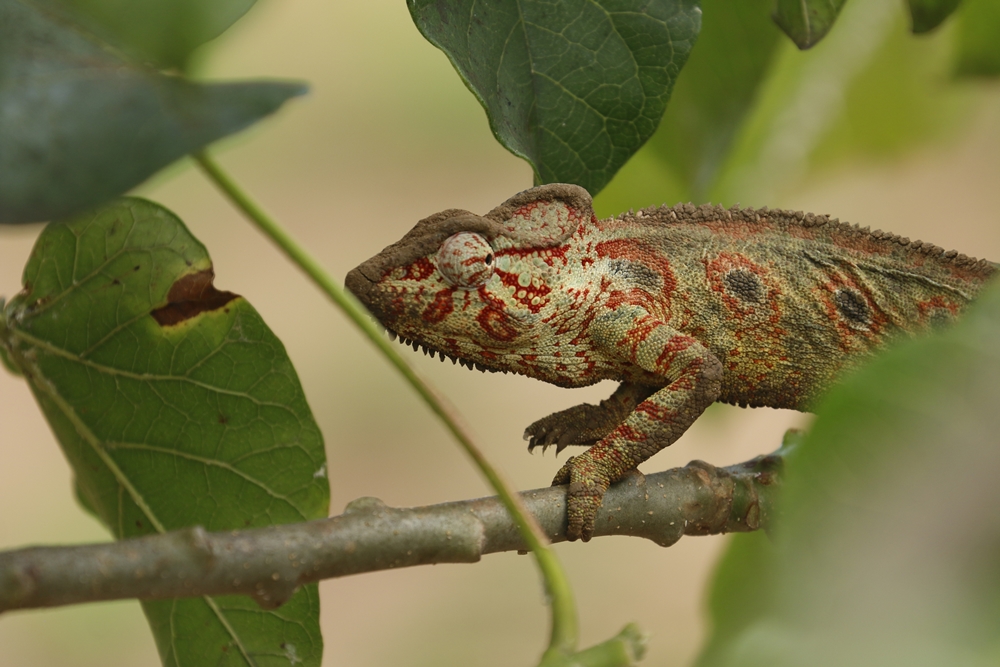
Parsons Chameleon
Our guide for both the evening walk and the day trek into the park was fantastic, finding some very special chameleon as well as the Indri and diamante sifaka. Being the wet season, we were lucky with the weather, having a dry evening and morning walk, with heavy rain in the afternoon.
Indri Lemur
The east coast of Madagascar is exposed to the Indian Ocean, so the French constructed inland canals joining the freshwater lakes to provide a sheltered 600km route for boats. On the edge of one of the lakes is a small resort surrounded by forest which has numerous habituated lemur. We were woken each morning by black and white lemur jumping across the forest in front of our cottage.
Diamante Sifaka
An island nearby has been created as a sanctuary for the strange Ari ari nocturnal lemur which has one extraordinarily long finger for prising insects out of their burrows, or crevices in trees. Locals fear the ari ari as they believe it brings bad luck, so they kill them, this island rescues them and tourist visits help pay for permanent security.

Ari Ari
Flooding in Diego Suarez
Our last week was spent in Diego Suarez at the very north of the island, enabling us to visit some of the most beautiful beaches, as well as visiting two areas of tsingy - pointed rock formations formed by erosion of the limestone, or surrounding rock, as well as a couple of national parks, each of which contains species found nowhere else. The town itself has many retired ex-pats, but the surrounding, hilly countryside was some of the poorest we had seen in Madagascar. Villages relying on subsistence rice farming, with no electricity or mechanical devices, where they shelter in wooden huts from the monsoon type rain. One 30 minute downpour resulted in water outside our hotel 500mm deep in which children were playing.

Diego Suarez
Local Village
Flying back to Tana before our return to South Africa we had good views of the inland areas of the island, scattered villages in long valleys with only a mud road, resulting in them being cut off from vehicle access through the wet season.
Back in Tana, the rice harvest and planting was in full swing. It is amazing how they have maintained rice paddies right near the centre of the city, but does provide a lot of open space. The harvesting was taking place from paddies under 500mm of water as they have had so much rain.

Tsingy

Main road to Tana from Diego Suarez


Crossleys Dwarf Lemur


Black and White Ruffed Lemur

Eastern Brown Lemur

Crowned Lemur


Highland Houses

Rive Harvest in Tana


Rock Thrush found only on Amber Mountain


Thursday, 23 January 2020

Amazing Madagascar

Smiling faces at Akany Avoko
After a returning from the UK in January we headed directly to Madagascar where we joined our son for a week. Madagascar is one of the 10 poorest countries on the world, but has immense life and colour as well as harbouring numerous unique species which are endangered by the continuing demand for land for its increasing population. In Antananarivo (Tana), the capital we visited Akany Avoko, an inspiring centre caring for young girls and providing them with education and skills for the future. Despite virtually no funding the director - who grew up in the centre - has managed to renovate buildings and provide a loving and caring home for 70 girls. An amazing lady who is helping to form some amazing smiling young people and deserves every bit of help she can get. Another visit to the country's developing scouting centre enabled us to see how vision and ambition can create fantastic facilities for Madagascar's scouts.
Main road to Tana near Fort Dauphin
After a few days in Tana we headed to Fort Dauphin on the south coast and the reserve of Berenty some 90kms (4 hours drive) west of the town. The main road here is in a shocking condition, some of the worst we have seen with large areas washed away and deeply rutted. As the road crosses the end of the mountain range the scenery changes dramatically, from relatively lush landscape to a much hotter and drier climate. Here the unique Triangular palm grows in a small area of forest before the flatter areas are dominated by the very strange spiny forest.
Southern Village
The plants have all evolved to be able to withstand hot dry conditions for much of the year with cactus like spiky plants.
Sisal Plantation


Dancing Verreaux's Sifaka
Spiny Forest
Ring Tail lemur Tree
Berenty is surrounded by sisal plantations which meet some of the growing demand for alternatives to plastic bags etc. and is an oasis for wildlife covering habitats ranging from the galleried forest along the river to spiny forest. These diverse habitats provide for a wide range of species, including ringtail lemur, Verreaux's Safika lemur as well as brown and red bellied brown lemur and the nocturnal white handed sportif, and grey brown moue lemur. These Sifaka are renowned for their "dancing". With short front legs and having to cross open ground, they have developed a sideways jumping method to cross between trees. We were out early and late for walks in the forest where we saw many of the mentioned species, and sheltered in the accommodation during the heat of the day, around 40 degrees.
Village Market
The local villagers are semi nomadic with their houses made from planks of wood which can easily be taken down and moved when necessary. A visit to their vibrant weekly market was amazing, so much colour and a lot of items such as cart wheels locally made, clearly a day out for everyone to see and be seen.

One of Fort Dauphin's Beaches
With a couple of days back in Fort Dauphin where it is somewhat cooler we were able to take a day trip to nearby Lokaro Bay, a stunning deserted white sand beach backed by a calm lagoon backed by beautiful mountains. A bit of a trek but worth the effort for its serenity. Fort Dauphin feels pretty remote, but has beautiful deserted beaches, great surfing waves and a very laid back atmosphere. The bus from Tana takes three days non stop driving, trucks can take up to two weeks so the only practical way in or out is via the twice daily 2 hour flight to Tana.
Lokaro Beach
Returning to Tana we met our driver and car and headed south along the main road, to visit some of the National parks and see the beautiful highlands.
Highlands scenery
Once we had left the congestion of Tana we were on a potholed tarmac road which climbed through the mountains passing villages where many people were working in the surrounding fields on all stages of rice growing. Ploughing, planting, weeding, harvesting and threshing. Amazing to see it all going on at the same time. As January is the wet season the whole area is very green with all shades possible on show.
Fianarantsoa Old Town
Ranomafana National park is part of the world heritage rainforest reserve and hosts some critically endangered species. One evening in pouring rain we were lucky to see mouse lemur and several species of chameleon, and the following day after climbing through the rain forest we were privileged to see the golden bamboo lemur, discovered in 1986, as well as the critically endangered greater bamboo lemur, among with sifaka and various chameleon.
South from Ranomafana we passed through Fianarantsoa where we visited the old very French part of the city.

Rice Paddies
Granite Domes
Beyond Fiana the road improves and the scenery starts to change - as the underlying rocks change from sedimentary to granite. Large smooth granite domes start to appear, some with impressive vertical faces several kms long, separated by grassland with rice fields in the valley bottoms. Agriculture becomes increasingly dominated by zebu cattle which graze on the open pastureland. Beyond the granite domes the land becomes poor fertility flat grassland at an elevation of 1000m. As it is the wet season it is all very green, but soon dries when the rain stops.
Isalo National Park
 
Our objective was Isalo National Park where we spent two days exploring this massive area of sandstone cut by deep gorges hiding small rivers and pools. Our circuit of the high ground was plagued by mist and rain, but the day exploring the canyons was perfect, not too hot for the stiff climbs.
Isalo National Park canyon
An extraordinary country with very a French feel to the towns and villages, which is enhanced by the vibrant markets


Ring Tail Lemur


White Handed Sportif Lemur                              Verreaux's Sifaka


Brown Lemur

Grey Brown Mouse Lemur


Golden Bamboo Lemur

 
Greater Bamboo Lemur
 
Chameleon
Chameleon


 .