Monday, 28 October 2019

Northern Namibia

Northern Namibia offers some extraordinary scenery with opportunities to get off the beaten track into the desert, and the remote Kaokaland region.
Rock art at White Lady
With no time pressure we have taken the opportunity to visit some of the more out of the way places. After a couple of days round Windhoek where we were able to get the air con repaired, and purchase much needed new tyres we headed back north and west, first visiting the remarkable white lady rock paintings. This collection of paintings in a remote rock shelter, 2kms up a very hot dry valley depict a shaman performing a dance ritual as well as the more common depictions of animals. What makes them remarkable is their use of colour in the artwork.
Unfortunately the front shock absorber lower support again fractured, so we headed to Swakopmund and West Coast 4x4 who made and fitted a new bracket.
Swakopmund Aquarium
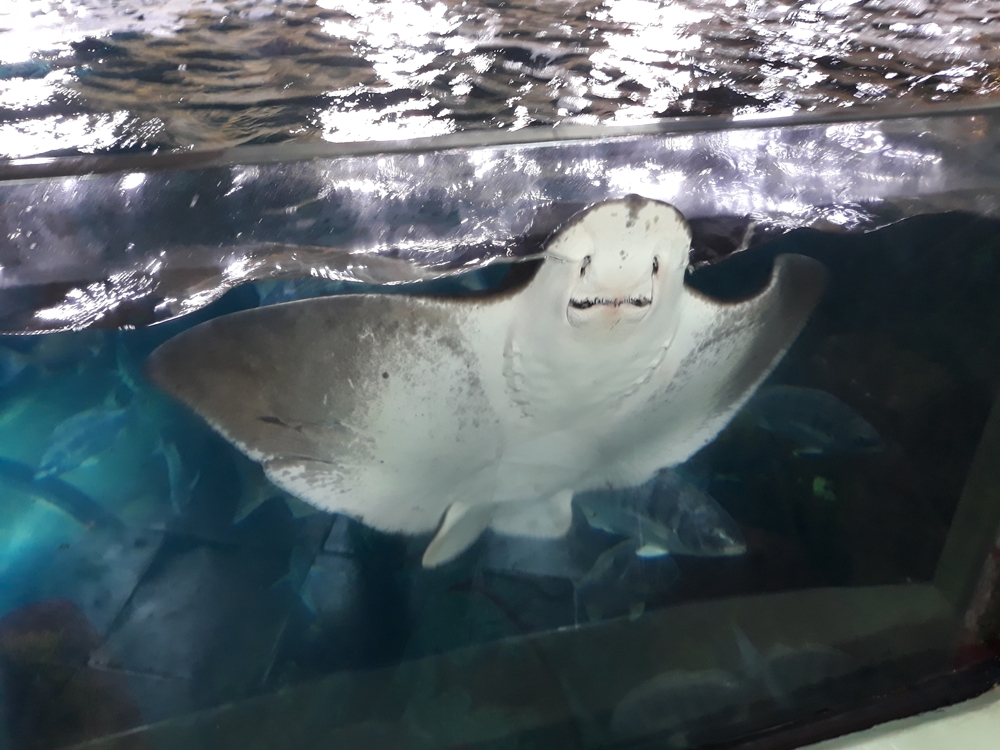
While waiting for the work to be completed we spent several hours in Swakopmund, a seaside tourist town with some lovely colonial architecture and an amazing aquarium with a walk through tunnel containing lots of local fish species. Viewing windows enable close up encounters with sharks and rays.
To get to the north we headed back up the Skeleton Coast passing the astonishing ancient lichen fields which rely on the daily mist which forms between the cold Benguela current flowing north from the Antarctic and the hot air coming off the Namib desert.
50kms inland from the coast is the Messum Crater - a shallow depression caused by a collapsed volcanic crater in the middle of the desert. Amazingly the effect of the Benguela current extends at least 50kms inland with cool nights and morning mist.
Camping in the Messum Crater
Following the dusty tracks we found the crater and camped under a nearby rock outcrop to shelter from the incessant wind. Such a peaceful location with fantastic night skies, and no-one within 50kms.

Huge Welwytchia plant
Rock formations along dry river
The track to the coast runs along a dry riverbed with some of the largest welwytchia plants which must be hundreds of years old, as well as some extraordinary eroded rock outcrops along the river edges.
Skeleton Coast shipwreck
Back along the Skeleton Coast the low tide exposed some of the numerous shipwrecks, as well as whale skeletons after which the coast is named. Such a remote place to be shipwrecked with no water to be found for 100kms or more.
Road into Kaokaland
Passing through the beautiful mesas of the desert we struck north towards Kaokaland and the home of the semi nomadic Himba tribe and the more settled Herero. Apart from one newly graded dirt road the north west is only accessible by some very rough "roads". The Himba still wear their traditional dress and herd goats and cattle, moving between grazing locations, staying in temporary stick and skin shelters. They have a base of more permanent houses of wood and clay houses round a thorny boma to protect their animals at night. It is amazing how they survive in this arid environment, have few possessions and a very light touch on the planet, yet seem generally contented.
Himba Village
Epupa at the northern point of Namibia where it borders Angola is a small dusty town on the Cunene River and has a wide waterfall. The creation of a hydro electric plant upstream means the waterfall is controlled so does not usually flood, however the power of the water flowing through the narrow gorge is amazing.
Following the Cunene river along the Angolan border is quite beautiful, with the blue river flowing between the dry thorn scrub landscape. After 5 years of poor rains the trees are still coming into leaf in expectation of the rainy season which generally starts in November.
Epupa falls
With a plan to head east towards Botswana we again crossed through Etosha for another opportunity to see the amazing wildlife concentrated round the waterholes. Thousands of zebra and springbok with some amazing viewings of black rhino and hyena.
We are now relaxing in Tsumeb while the gasket is replaced on the front differential of the van before heading to the Zambezi region (Caprivi Strip) before crossing into Botswana.
Cunene River


Tawny Eagle


Giraffe


Zebra at Oliphantsrus


Elephant at Ockakuejo


Black Rhino


Tuesday, 22 October 2019

Into Africa

Drakensberg Mountains
After a few weeks at home we returned to Durban in South Africa to collect our van from the shipping agent. After 120,000kms over some pretty rough roads the van needed some attention including new rear suspension and a full service, so after a recommendation from the local 4x4 club we left the van for a weeks work and rented a car to drive north of Durban and enjoyed a few days relaxing at a cottage at the foot of the Drakensberg mountains, then a few days in a beautiful thatched cottage beside a river near Ladysmith.
The Cottage near Ladysmith
View from cottage deck
British mass Grave nr Ladysmith
Apart from a visit to one of the Drakensberg parks where we walked to a small waterfall, and a visit to one of the battlefield sites relating to the siege of Ladysmith, we spent the time reading and relaxing.
when we were reunited with the van we had just a week to get to Cape Town where we were meeting Sue's brother David, who was joining us for just over to weeks. It was a bit of a dash along the wild coast and garden route, but with fairly persistent drizzle there was little incentive to stop anywhere for long.
Cape Town from Table Mountain
Cape Town is located in a beautiful bay beneath Table Mountain and we spent a couple of days when we visited Table Mountain, via the cable car, and then round to Fish Hoek and the Boulders Bay penguin colony. Despite it being cold and drizzly the penguins provide endless entertainment, some sitting on tiny penguin chicks.
Penguin Colony at Boulders Bay
David was very keen to go cage diving with great white sharks so we drove along to Gansbaai, the centre for cage diving and he spent an afternoon out on a boat, spending three sessions in the cage surrounded by 3m long bronze whaler sharks, sadly no great whites appeared.
Entertaining Penguins
On a more gentle whale watching cruise we were saw around eight southern right whales, and were treated to a mother and baby swimming right in front of the boat.

Fish River Canyon

Beautiful Orange River

With 10 days left we decided to head north to Namibia, spending a couple of long days driving to get to the border at the Orange River, before making our way north via the spectacular Fish River Canyon - the second largest canyon in the world after The Grand Canyon. Tracks along the rim provide a range of vantage points , but being the dry season there were only small pools of water in the bottom.

Quiver Tree Forest
Camping at the Quiver Tree Forest provided the opportunity to see three cheetah at close quarters. They had been orphaned so were rescued and brought up by a couple of greyhounds, and now live in large fenced areas on the farm. The Quiver trees, which are endemic to this region of Namibia grow on the dry rocky land and against the regular beautiful sunsets produce a memorable silhouette.
Dead Vlei Pan Soussousvlei
Namibia offers a range of interesting dry landscapes, and none more enchanting than the worlds biggest sand dunes at Soussousvlei. Although very hot during the day the white salt pans with their trees set against the red of the dunes and the blue sky make for a memorable spectacle. Climbing the dunes, although exhausting, enables you to gain a view of the sand dunes disappearing off into the distance, and in the evening sun the beautiful curves of the dunes are enhanced by the sharp shadows. 
Soussousvlie dunes
In contrast the Skeleton coast with the cold Benguela Current running up it can be very cold. With virtually no rainfall the only moisture available is from the nightly fog which forms for many kilometres inland. This moisture is sufficient to sustain fields of lichens, some of which are hundreds of years old.


Cape Cross Seal Colony
The Cape Cross Seal colony part way along the coast is home to several thousand Cape Fur seals, and we spent several hours watching the mothers feeding their young, as well as an opportunistic Black Backed Jackal which snatched a newly born pup from its mother. Sad, but all part of the realities of life.
Welwytchia Plant
Heading inland from the coast we passed the strange Welwytchia plant, also endemic to this part of Namibia. Welwytchias are very slow growing with some plants believed to be over a thousand years old.
Twyfelfontein Rock Art
Twyfelfontein is home to several thousand ancient rock carvings, some believed to be 5,000 years old. Pictured on the rocks in this valley are many kinds of animals, including seals and penguins from the coast 100kms away, a famous lion with a hand on the end of its tail, believed to be related to a shamanistic rite, and an area of carvings with animals and their spoor which was believed to be a teaching area.
Our final destination on this whistle stop tour was Etosha National Park, where we spent three incredible days/nights watching animals. The first night we were treated to a family of 25 elephant at the waterhole followed later by three black rhino, and even a black and a white rhino at the same time.
Black rhino meets white rhino in Etosha
Across the plains of Etosha the animals congregate near the waterholes, as at the end of the dry season there are few options for water. herds of hundreds of zebra, springbok and wildebeest mixed with oryx, elephant, ostrich, and impala.
Animals concentrated round the waterholes
Oliphantsrus Waterhole on the west provided the most special sightings. A viewing platform has been built right near the waterhole with the platform above the animals, so they are generally unaware of your presence. In addition to the previously seen animals red hartebeest joined the fray. Later during the night rhino and elephant came along with an Eland, and in the distance both a spotted and a brown hyeana. During the night we were woken by loud lion roars just outside the fence from our campsite, and in the morning three male lion were still near the waterhole. Beautiful in the morning sun.
Resting Lion
At our overnight stop on the way back to Windhoek, eland, waterbuck and impala were wandering round the campsite grounds, and David to his delight found a waterbuck antler, which he was allowed to keep. A fantastic few weeks, but very hectic including driving some 6000 kms. We are now ready to slow down for the next phase of our Africa travels.


Mother and baby southern right whale

 
Black Back Jackal

 
Giraffe leaving


Black Rhino                                                                        Lion Brothers


Gemsbok, or Oryx


Busy zebra waterhole

The Baby of the Family


Floodlit Waterhole


Northern Namibia


Thursday, 15 August 2019

Goodbye to the Sub-Continent

Leaving the Swat Valley
The beautiful Swat Valley
Swat Valley is associated with the insurgence of the Taliban who took temporary control in 2007, but is now a peaceful fertile agricultural area growing lots of fruit and vegetables for the markets of Islamabad and Peshawar. This beautiful valley is now a base for the re-assembly of cars smuggled in from Afghanistan on mules and camels to avoid Pakistan's high import duties but which can be openly used in the semi autonomous northern states. Whole towns seem to be full of car parts for any vehicle.
Takht e Bhai Monastery
However the day we were there the monsoon was in full swing at the top of the valley, so we headed south away from the rain to Takht e Bhai - the site of a first century Buddhist monastery complex where students were taught. The remains, scattered over a ridge command wide views over the plains and are believed to be representative of the Buddhist architecture of the time. A few locals were visiting, but we had an armed guard, whether to protect us or the ruins we were unsure.
Greek city of Sirkap
Nearby Taxila was a major town by the Indus and straddling the major route trade from the Khyber Pass east  to India. The area had been occupied for millennia with evidence of Buddhist towns dating from the 5th century BC. A superb collection of artefacts is displayed in the museum, ranging from statues to arms and coins from many countries. Part of the Taxila complex is the ancient town of Sirkap, founded in 180BC by the Greek invader Demetrius and was a fortified by massive walls with a planned grid of streets and temples, some exhibiting typical Greek Corinthian columns, unusual for this part  of the world.

Replacing differential gasket
After a day in Islamabad where we needed to get the front differential gasket replaced, amazingly quick and professional work by the team at Auto Club, we headed to the Indian border, as a state of emergency had just been declared in Kashmir. Crossing back to India we again passed through the gate where the border ceremony takes place and were soon in Amritsar.
Pakistan / India Border gate
There are two iconic places in Amritsar, Jallianwala Bagh - where General Dyer ordered his troops to fire on unarmed locals celebrating their New Year in the gardens, massacring hundreds, and starting the call for independence from Britain. A memorial stands in the garden and the bullet scarred walls have been retained.
Just nearby is the famous Golden Temple - the most holy site for Sikhs and an astonishing place.

Monument to those killed in the
struggle for independence
Despite the thousands of visitors and pilgrims who visit every day there is an air of respect, and a very efficient and unobtrusive process for managing the visitors, from around 15 windows where you can leave your shoes safely with staff, to the mass free feeding of pilgrims as they visit.
Golden Temple Amritsar
There seems to be a permanent queue along the causeway to the temple which is very ornate.

The evening was spent attending the extraordinary border closing ceremony, which has become a major attraction. The crowd on the Indian side starts arriving two or more hours before the ceremony filling the huge stands which have been constructed. Loud lively music is played and despite the heat the crowds dance, sing and wave flags.
Indian soldier at border ceremony
This is then orchestrated by a military cheer leader who encourages the crowd into ever louder cheering with women invited to parade flags and dance in the centre - all very Bollywood. The activity on the Pakistani side is rather more subdued with fewer visitors. The ceremony itself is also extraordinary with soldiers in incongruous uniforms from each country marching towards each other with a high kick before making aggressive gestures in a face off. Finally both flags are carefully lowered in exact timing with each other, before a handshake and the gates are slammed. - All rather strange.

With less than a week until we load the car in Mumbai we headed south along the well made and fast  road, passing Delhi and arriving at Jaipur. The incredible Amber Fort is huge, with walls stretching up and across the nearby hills, looking just like the Great wall of China.
Amber fort at Jaipur
Ornate halls and chambers can be explored at will, with numerous passageways and staircases available to explore. It would be easy to spend a day following all the possible passageways, but with limited time we restricted ourselves to the main areas. The sumptuous tilework and huge proportions make you realise the wealth and power of the Maharajahs.
Worlds largest stone sundial at Jantar Mantar - Jaipur
Jaipur itself is having a metro system constructed so the centre is somewhat disturbed, but the pink city boasts some splendid moghul architecture, especially down some of the back lanes where dilapidated houses often have a very ornate doorway, or lovely balcony.
One of the more unusual places is the Jantar Mantar collection of huge astronomical instruments constructed in the 18th century by a keen Indian astronomer and boasts the worlds largest stone sun dial. Quite extraordinary. Nineteen sets of instruments have been constructed to predict the movement of celestial bodies in each of three coordinate systems.
Udaipur Palace
Our final stop en route to Mumbai was Udaipur where under drizzly skies we visited the huge palace which again has numerous highly decorated rooms and some wonderful architecture, but on a vast scale, with the courtyards separated by low and twisting passageways.
Udaipur ornate interior
In Mumbai we successfully loaded the van into the shipping container ready for its journey to Durban where we will meet it in three weeks time.


Loaded ready to ship to Durban


Highly decorated Pakistani bus

 
Ornate backstreet doorways


Interior of Mumbai railway station